Logistics operations require visibility, traceability, and adaptability across diverse contexts: last-mile delivery during campaigns, tracking of vehicles or equipment, or monitoring stock levels across facilities and administrative units. Rather than imposing a single logistics model, IASO provides two complementary and configurable approaches to logistics, depending on whether the primary need is object tracking or stock management across geographic units.
These two approaches can be used independently or combined within the same programme.

1. Logistics through entity-based tracking
Tracking objects, assets, or resources over time
IASO’s entity framework allows any object of interest to be represented as a digital entity and tracked over time. In this model, an entity can represent:
-
a household or beneficiary (e.g. distribution campaigns),
-
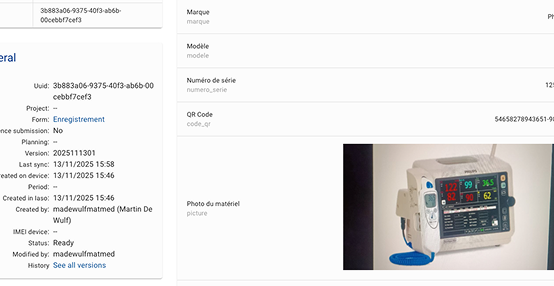
a piece of medical equipment,
-
a storage container, kit, or asset,
-
or any other object that needs to be followed longitudinally.
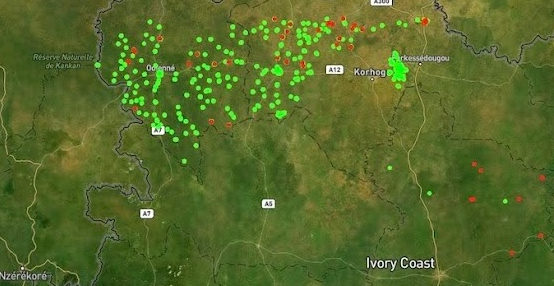
This approach has been used, for example, during the LLIN distribution campaign in Côte d’Ivoire, where entities represented households and distribution units, and in logistics use cases where entities represent vehicles or medical equipment.
Object-level traceability and events
When logistics are handled through entities, each object has a unique digital profile, its attributes (type, status, location, responsible unit, etc.) can evolve over time, and events can be recorded at any stage of its lifecycle.
Events can represent concrete operational moments, such as:
-
a delivery or transfer,
-
a safety or maintenance check for a vehicle,
-
an inspection or calibration of medical equipment,
-
a handover between teams or locations.
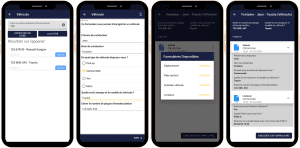
Each event can trigger specific data collection forms, allowing programmes to ask targeted questions (for example, vehicle condition, equipment functionality, compliance checks) and to build a complete, auditable history for each object.
2. Logistics through the supply chain module
Managing stock levels by geographic unit
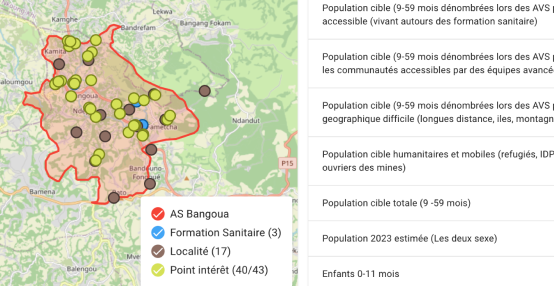
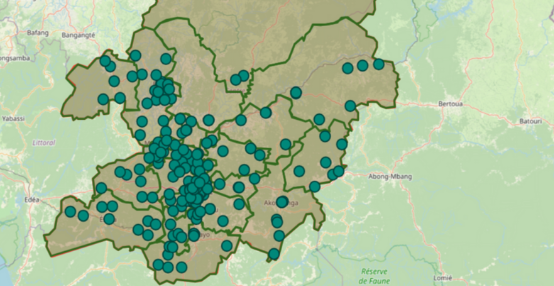
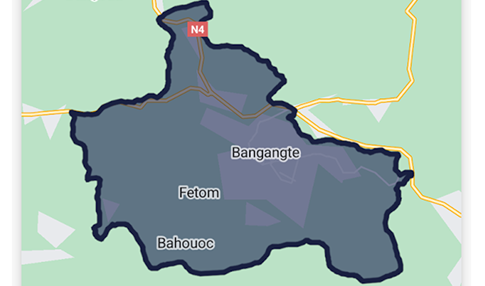
In parallel, IASO includes a supply chain module designed to manage logistics at the level of geographic or operational units, such as facilities, districts, regions, warehouses or hubs.
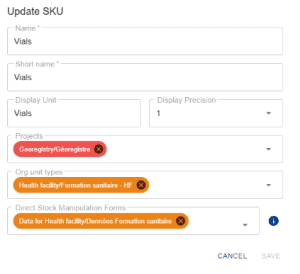
These units are configurable in the web application and aligned with the georegistry used across IASO.
Stock management linked to geography
In this model, each geographic unit maintains a stock level for one or more commodities, stock movements are recorded through forms that add to or subtract from the unit’s stock, and stock levels are automatically updated based on these transactions.
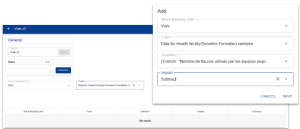
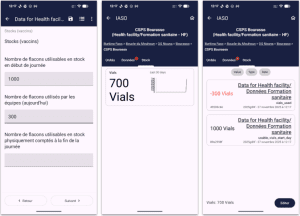
Field teams can view current stock levels directly from the mobile application, edit or correct stock values when needed (with traceability), and record incoming or outgoing movements during routine operations or campaigns.
Visibility across neighboring units
IASO also allows users to check stock levels of neighboring geographic units in real time, identify nearby facilities or districts with available stock, and make operational decisions accordingly (redistribution, emergency resupply, coordination).
This geographic visibility is particularly valuable in constrained or emergency settings, where rapid reallocation can prevent stockouts or service interruptions.
Monitoring logistics in real-time
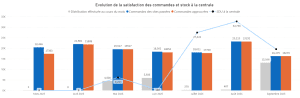
IASO collects the data about stock levels or supply chain movements, and then the data can be sent to central level to build insightful dashboards giving decision-makers insights in real-time.