500 meters in 10 hours. On the Kisangani-Buta axis, in Bas-Uélé province, that is the pace imposed by roads turned into quagmires during the rainy season. These conditions did not prevent PNECHOL teams from being trained in community health data collection with AppSSC, an application built on IASO. A look back at the training held under the SANRU Extension App SSC project: the access obstacles the team overcame, and what they reveal about data collection in the most remote areas.
Reaching the health actors of Bas-Uélé goes well beyond a simple administrative trip. In this province of the Democratic Republic of the Congo (DRC), the state of the roads alone redefines a team’s schedule and a project’s feasibility.
On the Kisangani-Buta axis, the team had to face impassable stretches, free bogged-down vehicles by hand, and advance, literally, meter by meter. This reality is far from anecdotal: it illustrates the concrete conditions in which any data collection in a remote area must be organized, well before the first data point is entered on-site.
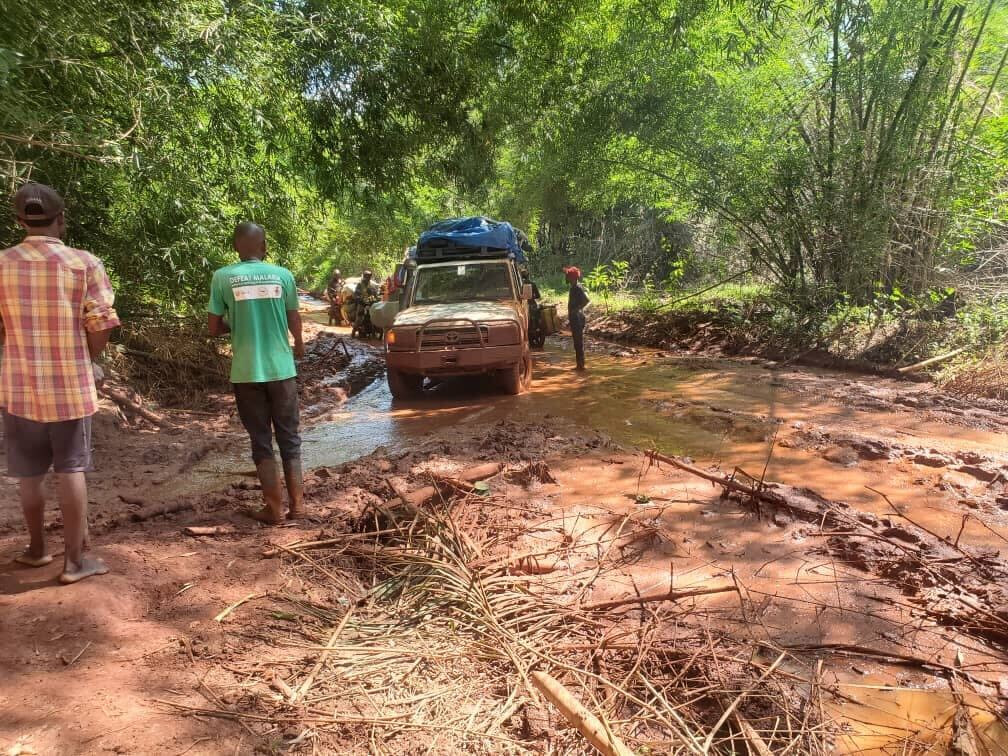
Faced with these conditions, the team’s progress relied on the mobilization of community members. Their support, meter by meter, enabled the team to reach its destination and achieve the set objective. This solidarity is a reminder that the success of an on-site project, however well equipped technically, depends first on the relationships built with the communities concerned.
These logistical obstacles were, however, only one step: the central focus of this operation remained the training of the health teams themselves.
The goal of this trip was to strengthen in-country data collection capacity as part of a national public health project. This training is part of the SANRU Extension App SSC project, whose objective is to equip the province’s community health teams with a reliable data entry tool. Once the team arrived on-site, the training of the PNECHOL teams was able to take place successfully.
The tool at the heart of this training is the AppSSC application, powered by IASO. It allows community health teams to directly enter reliable, structured data on-site, without depending on a continuous connection or heavy infrastructure. Thanks to this training, the province now has the tools needed to organize consistent community data collection that the relevant health actors can use.
This technical and human success illustrates a broader conviction, which guides all interventions in this type of context.
The Bas-Uélé experience goes beyond a single on-site operation. It raises a fundamental question: what happens to the areas that cannot be reached?
The more difficult the context, the more the commitment to ensuring reliable access to health data must be strengthened. Every intervention, even in the most remote areas of the DRC, must be able to rely on accurate information to guide the decisions of public health actors. This conviction is what motivated continuing the training despite the obstacles encountered on the Kisangani-Buta axis.
The training of the PNECHOL teams in Bas-Uélé is a concrete step toward this goal. By equipping community health teams with a data collection tool adapted to their context, this project contributes to better information flow from the hardest-to-reach areas, supporting decisions made at the provincial level.
The PNECHOL training in Bas-Uélé shows how IASO supports community data collection, even in the most constrained logistics contexts. Collecting reliable data in hard-to-reach areas is also at the core of public health campaigns, from microplanning to real-time monitoring. Learn more about campaign digitalization with IASO.