Pathways uses a woman-centered segmentation process to understand how social, behavioral, economic, cultural, and environmental factors relate to health outcomes. The approach gives research teams a way to look beyond averages and consider the different experiences of women and their households. Once segments are defined, a practical challenge remains: How does a field team identify the people it needs to hear from? This is where IASO, through the Pathways typing tool and the recruitment process, supports the next step of the work.
A segmentation is only useful if research can reach the people it describes. Qualitative research that ignores this risks over-representing the easiest people to find and missing the experiences a segmentation was built to surface.
A woman-centered segmentation groups women and their households by the factors that shape their health outcomes, not by demographic averages alone. It gives a research team categories grounded in real differences in behavior, resources, and environment, rather than a single composite profile.
Recruitment is the process of finding and approaching people who fit a study’s research needs. A Pathways team may need participants from particular segments so that qualitative research includes a wider range of experiences, including those of groups that are harder to find. A recruitment plan sets the target segments, sample size, and quotas that guide this on-site work.
Once a segmentation exists, a team still needs a way to apply it during recruitment without repeating the full survey that built it.
Pathways typing tools ask a series of questions in a particular order to type, or place, a person into a Pathways segment. A statistical model predicts the segment from the person’s answers. The typing tools are created after the segmentation is complete: letting a team apply existing work directly, rather than running a full survey again. The questions can be presented as a decision tree on paper, an XLSForm for compatible tools, or a digital version, for instance with IASO.
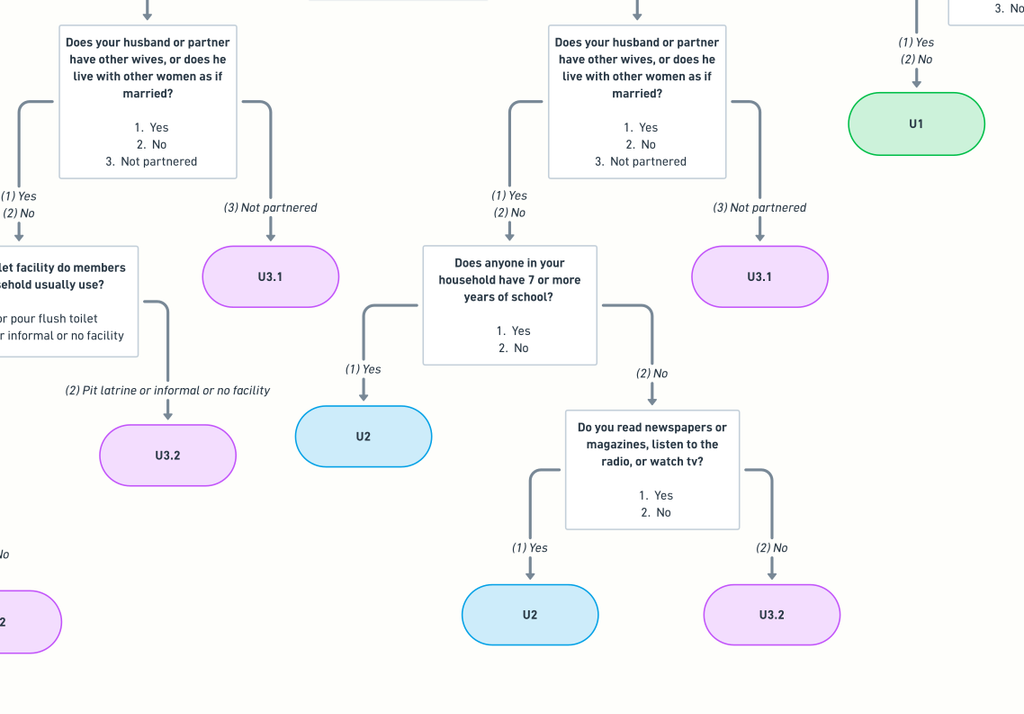
Field recruiters meet potential participants, ask the relevant questions, and use the typing tool to predict each person’s segment. Depending on the study, they may also ask screener questions to check eligibility, quota questions to meet other research targets, and additional questions for information needed ahead of an interview. The usual sequence is screener, typing tool, quota, then additional questions.
An example of a typing tool on the web
Teams can use IASO to run Pathways typing tools and to follow recruitment, both on-site and from a computer.
In its mobile app, field recruiters ask typing questions in the required sequence, capture responses, and see the predicted Pathways segment. The app can be used without an internet connection; completed forms are uploaded to the server once a connection is available. The Pathways typing tools are designed to be ODK compatible and are available in any country with a Pathways segmentation: Indonesia, Kenya, Nigeria, and Senegal, with Ethiopia and Pakistan upcoming.
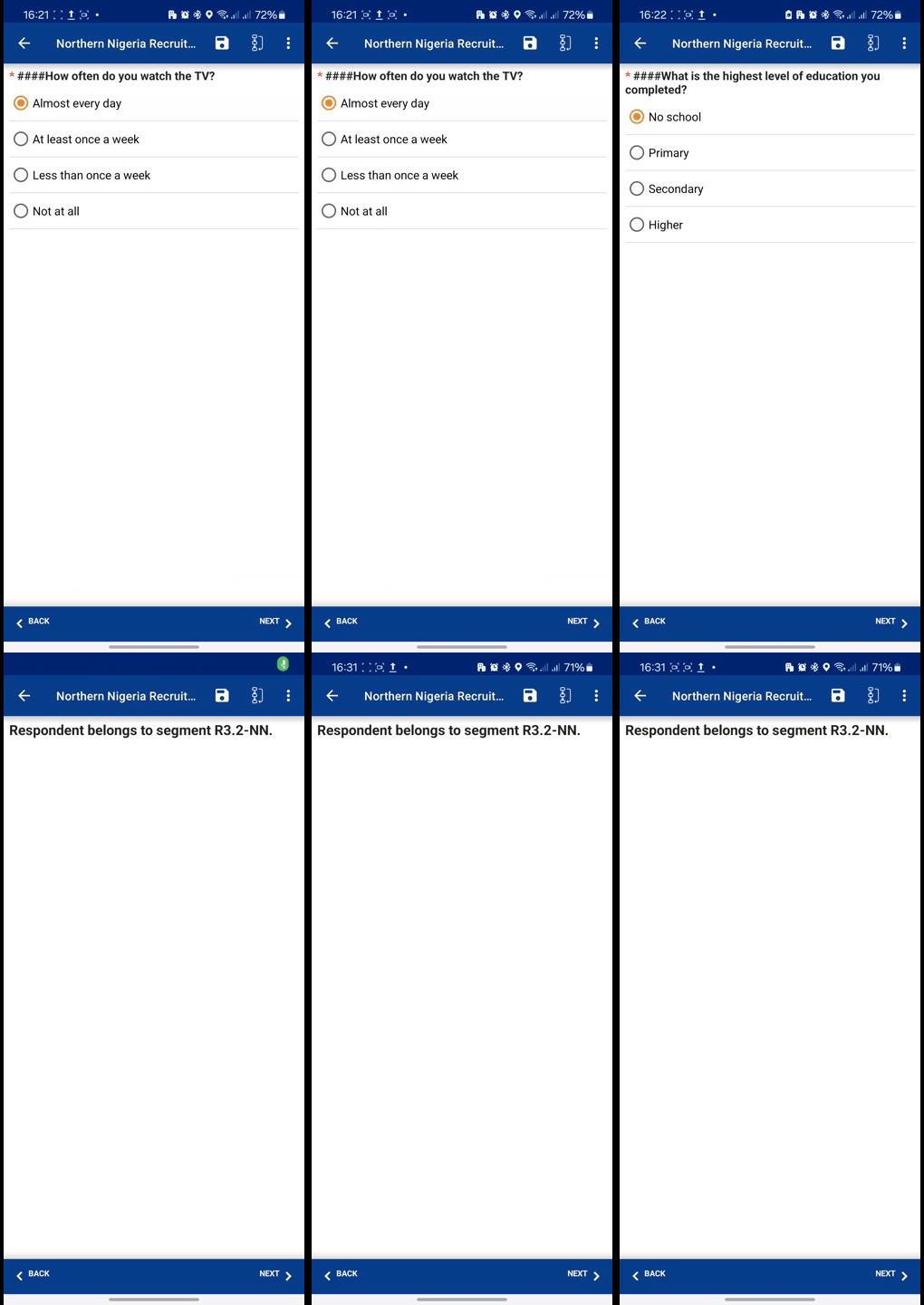
Pathways typing tool mobile app
In the web app, recruitment or research managers manage the forms and view submissions.
Collecting typing responses is only part of the work; managers also need to see how recruitment is progressing against the plan.
Submitted forms can also support recruitment monitoring. An OpenHEXA pipeline synchronizes IASO submissions to a database that feeds an Apache Superset dashboard. The dashboard shows typing-form uploads over time and a breakdown by segment, with filters for segment, data collector, and date.
Managers can use this view to see which segments are appearing among the people assessed, and where further recruitment effort may be needed.
There is a distinct role for IASO in helping teams apply an existing segmentation during recruitment, capture typing responses, and review activity across field teams. IASO does not build the segmentation itself; it gives teams a practical, on-site and offline-capable way to put a completed segmentation to work in qualitative research.
To see how Pathways defines its segmentation approach and tools, visit the Pathways Resources page. To learn more about how IASO supports data collection projects like this one, contact us.